
Middlesex Blotters Are Municipal
The Middlesex Sheriff's Office publishes no multi-day arrest log, no current roster, and no booking-photo feed. Local police departments write the first incident and arrest records. Someone arrested in a city may enter the Middlesex Jail & House of Correction. They may be released instead. Or they may transfer elsewhere. So the city record and the sheriff admission record are not interchangeable.
Cambridge Police posts a Daily Log with dated pages. Each entry carries arrest and warrant labels. It also lists an incident number, time, location, the alleged offense, and a short narrative. What it does not give you is the county booking number, bail, release status, or booking photo. Lowell and Newton both offer official records paths. Neither city publishes a current public daily blotter.
This wider-window approach differs from an Arrests Last 24 Hours check, which aims at quick confirmation. Blotter searching instead works backward through dated sources, then follows the record into archives.
Read Cambridge Arrest Entries
Start on the official Cambridge Police site. Open the Daily Log and pick several dated pages around the event. Read the labels and the narrative carefully. The date in a page heading usually marks the activity day. The publication date can fall later. Check both sides of the expected date, especially for overnight incidents, weekends, or holidays. The Cambridge Police Daily Log archive page shows this dated municipal format in action.
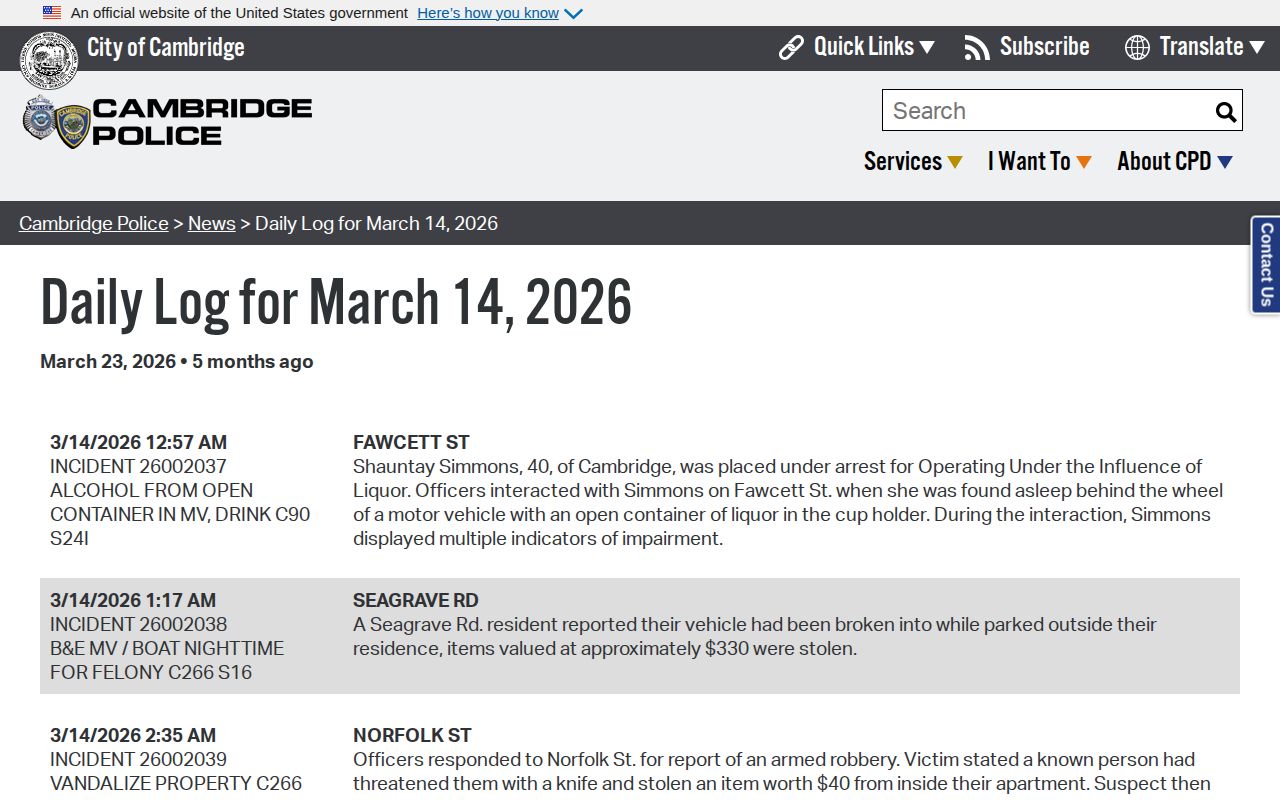
The capture illustrates why event day and web publication day must be recorded separately.
- Start with the expected event day. Note the location, time, and arresting agency.
- Open nearby dates. Include later publication days rather than assuming a missing entry.
- Match the incident number. This is often safer than relying on a name alone.
- Separate narrative from outcome. The police summary describes the initial event, not the final case.
- Request the file when needed. Ask Cambridge Police Records for the identified incident report, subject to lawful restrictions.
A blotter gives you a starting point and nothing more. It cannot confirm someone is still held in Billerica or tell you how a judge resolved the case.
Middlesex Arrest Log Fields
A municipal log is deliberately narrower than a correctional intake record. Massachusetts county correctional rules list many fields a jail may collect. Public release still depends on the records law. Privacy limits also apply. So do investigations, juvenile rules, and medical protections. The Cambridge fields described here reflect what the public log actually contains.
| Log field | How to interpret it |
|---|---|
| Incident number | Municipal identifier used to request or compare police records. |
| Date and time | Reported event timing, not necessarily publication or admission time. |
| Location | Place associated with the incident; it does not identify a jail. |
| Arrest or warrant label | Signals police action, but not present custody. |
| Alleged offense | Initial charge language that can change in court. |
| Narrative | Brief police account, often without full supporting reports. |
| Booking number and bail | Not shown in the reviewed Cambridge log. |
| Photo and release | No booking photo or reliable current-release field in the reviewed entry. |
Never infer age or identity from a name or an unofficial image. Ask for the originating record. Then compare it against the court case, since charges often change, shrink, or vanish.
Weekend Middlesex Reports Can Lag
A calendar-day log does not always appear on that same day. Cambridge pages have shown up days after their event dates. The lag deepens around weekends and holidays, when processing schedules shift. No fixed publishing hour exists. No weekend timetable is guaranteed either.
Search backward and forward from the likely date. A late-Saturday arrest might land on the Saturday event page. It could also appear on Sunday or Monday activity. Or it might sit on a page published even later. Use the incident number and place to settle close matches. And remember that a burst of delayed posts does not mean arrests spiked. It may just be the publication cadence catching up.
The county recent-arrests overview lays out the separate sheriff, city, court, DOC, and federal routes for following up a municipal entry.
Older Middlesex Arrest Records
Once the public log window closes, send a focused request. Address it to the agency that created the record. Cambridge Police holds its own incident material. Lowell Police Records routes Lowell report requests, and Newton Police runs a department records portal. The person may have entered county custody. If so, the Middlesex Sheriff's Office may hold an admission, commitment, discharge, or central-case record.
For MSO records, name the person. Give approximate arrest and admission dates. List the originating department and incident number if known. State the exact record you want. Electronic delivery is worth requesting. Records Access Officer Megan McLatchey is listed at 12 Gill Street, Suite 4700, Woburn, MA 01801. Her phone is 781-960-2830. A response may redact exempt material. It could narrow your date range or send you to a city or court instead.
Under Massachusetts' 2026 statewide schedule, sheriff commitments and discharge logs are permanent. Central-case photographs and fingerprint cards are permanent too and eligible for the Archives. Other central-case material, including booking and registration documents, carries a six-year schedule. That term is followed by electronic recordkeeping. These retention rules set minimum custody periods only. They promise no public access and no online archive.
- Retention
- The minimum period an agency must preserve a record.
- Archive transfer
- An approved move to archival custody; not proof of public online access.
- Disposition
- The court’s final result, distinct from records disposal.
- Redaction
- Removal of protected content from an otherwise responsive record.
For historic material, first ask MSO. Ask whether it still holds the record. Then ask Massachusetts Archives about a J09 transfer, naming the facility, the date range, and the record series. Older court records answer to court rules. They do not follow the sheriff schedule.
News Is Not an Arrest Log
Start with outlets that cover Middlesex County directly. Boston 25's Middlesex County section follows arrests and court cases in Cambridge, Lowell, Newton, Malden, and nearby communities. Patch Cambridge Police & Fire tracks local police news, though its posting pace varies. The Lowell Sun handles Lowell and the northern towns. None of these is a booking register. Photos may be police handouts, video stills, or generic art.

Mugshots.com keeps an unofficial Middlesex County page. Most of its material runs from 2013 through 2015. The historical unofficial county page shows why its dates and disclaimers deserve a closer look. Busted Newspaper, RecentlyBooked, Arrests.org, and Mugshots.zone offer no Massachusetts Middlesex feed. Aggregators never replace the blotter. An arrest story can add context, but Lowell Police and the court own the record itself.
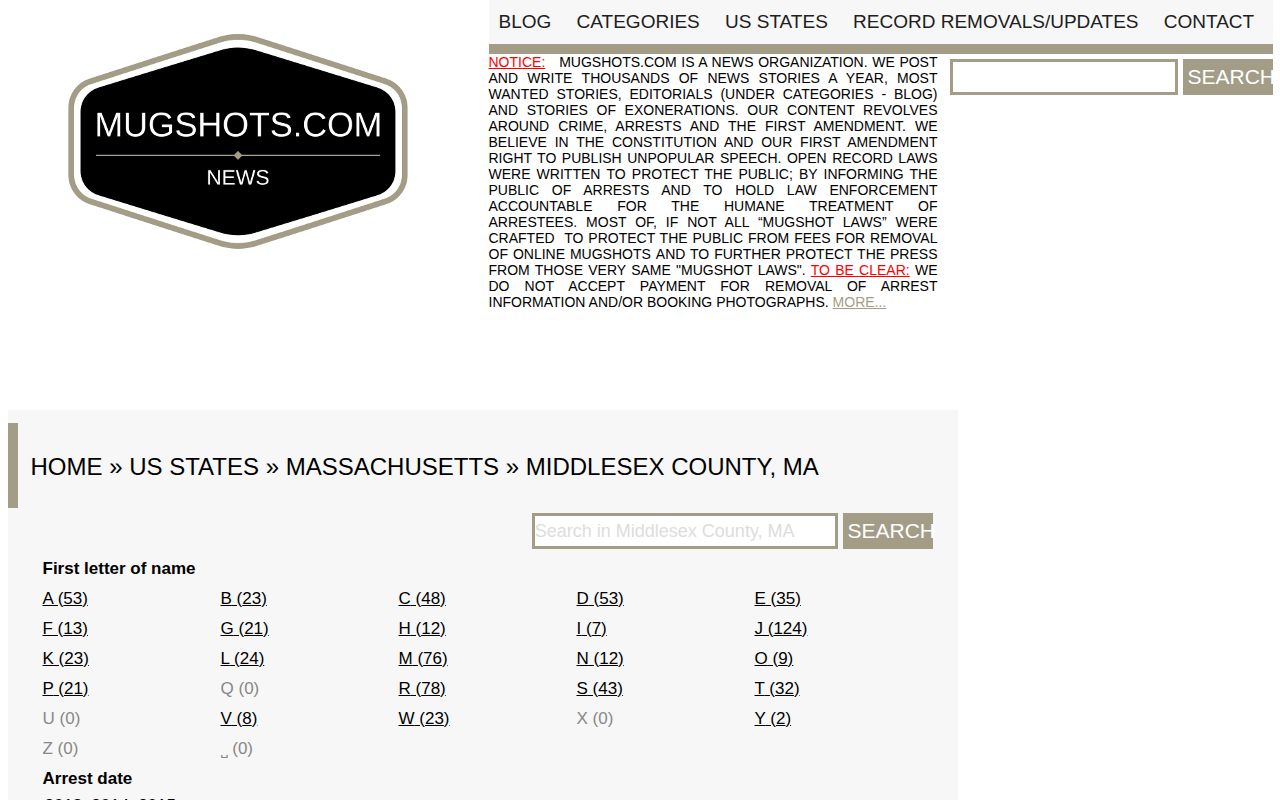
Treat aggregator pages as background on where arrest data sits, not as a Middlesex booking roster.
Verify Middlesex Arrest Outcomes
A blotter entry is just the start of a record trail. Charges can change. Check the court docket or the clerk's record for the outcome of a Middlesex case. Ask the holding agency about current custody. Good notes help. Save the source URL, the event date, the publication date, the incident number, and the agency name. That keeps the chain from city police to county jail and court clear. A later records request stays precise too. No unofficial record should override the government file.
Public Record Search
Sponsored Results